
Stake Plinko is a provably fair Stake Original where you drop a ball through a triangular peg board and it lands in a multiplier bucket. Published RTP sits around 97–99% depending on rows and risk. Low risk keeps you alive; high risk swings hard. Pick the setting that matches your bankroll, set deposit limits, and treat the 1000x bucket on 16 rows as a fun outlier, not a strategy.
What is Stake Plinko?
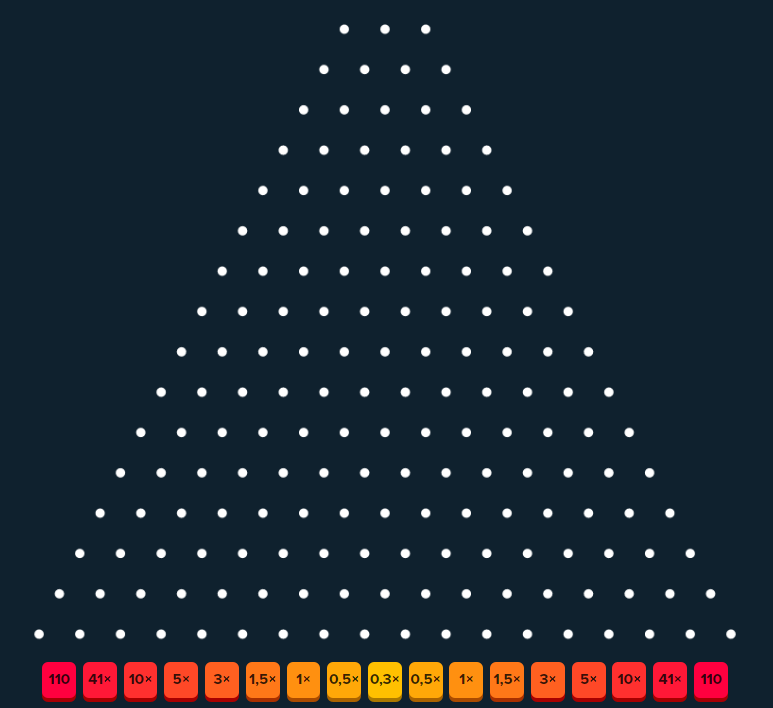
Plinko is one of Stake's in-house Originals — the same lineage as Crash, Mines, Limbo, and Dice. You set a wager, choose how many rows of pegs the ball passes through (8 to 16), pick a risk level (low, medium, or high), and drop the ball. It bounces left or right at each peg until it lands in one of the buckets at the bottom. Each bucket has a multiplier, and your wager is multiplied by whichever bucket the ball lands in.
Two things make Stake's version stand out from the older Pragmatic Plinko or BGaming clones Canadian players might have seen elsewhere: cleaner provably fair tooling, and a 1000x outer bucket on the 16-row high-risk preset. It's the same simple game underneath, just better-packaged.
How Stake Plinko works
The board is a symmetrical triangle of pegs. The ball is released from the top centre and at every peg it has a roughly 50/50 chance of going left or right. The further the bucket is from the centre, the harder it is to reach. So buckets closer to the middle pay close to 1× (or less, on high risk), and outer buckets pay much more.
That distribution is a normal-looking bell curve in low risk, with most outcomes landing near the centre and only a long-tail chance of hitting the extremes. High risk thins out the middle (most middle buckets pay less than 1×, sometimes 0.2× or 0.3×) and pumps the outer buckets up to the 88×, 130×, or 1000× range. The total expected value still matches the published RTP — high risk just redistributes the same money into rarer, bigger wins.
Drop modes
Stake Plinko supports single-ball play and an autoplay mode where you queue 10, 100, 500, or 1000 drops with stop-on-loss / stop-on-win conditions. Autoplay is convenient but easy to abuse — the speed makes losses pile up quickly if you've sized your bet too aggressively.
Stake Plinko RTP and the provably fair system
Stake publishes Plinko's RTP per row/risk combination. The numbers you'll see in the game info panel are typically in the 97–99% range, which is competitive with most Stake Originals. RTP is a long-run statistical figure — over hundreds of thousands of drops the math holds, but on any individual 100-drop session your variance can be massive in either direction.
Provably fair means each outcome is generated using a server seed (Stake's), a client seed (yours, which you can change), and a nonce (incrementing counter). After the round is settled, Stake reveals the seed so you can verify the outcome was determined before you dropped the ball. If you want to confirm it for yourself, rotate your client seed regularly and check a few rounds via the verification tab.
Low risk vs high risk: what actually changes
The risk setting is the single biggest decision in Plinko. Here's the practical difference, based on the 16-row board:
| Setting | Centre buckets | Outer buckets | Feel |
|---|---|---|---|
| Low risk | ~0.5× – 1.6× | ~16× max | Slow grind, small wins frequent, rare ruin |
| Medium risk | ~0.3× – 1.4× | ~110× max | Middle ground; some swing without total chaos |
| High risk | ~0.2× – 1.0× | ~1000× max | Bankroll bleed in the middle, jackpot dreams on the edges |
On high risk, most drops will return less than your wager. The math expects the rare 1000× hit to make up the difference over a long run — but "long run" can mean tens of thousands of drops. In a 100-drop session you'll usually be down. That's the trade.
Best Stake Plinko settings for different player types
The grinder
16 rows, low risk, small bet (0.1–0.5% of bankroll). Long sessions, small ups and downs, slow rakeback accumulation if you have the GETRAKEBACK code applied — see the promo code page.
The casual player
12 rows, medium risk, moderate bet. Faster session feel without high-risk volatility. Good fit for an hour of entertainment without the bankroll roller-coaster.
The multiplier hunter
16 rows, high risk, small fixed bet. You're paying for the chance of a 1000× hit. Treat losses as the cost of the lottery ticket and set a strict session budget.
Understanding multipliers and the 1000x payout
The 1000× bucket only exists on 16 rows, high risk. Its probability is in the tens-of-thousands-of-drops range — roughly a 1-in-15,000 to 1-in-25,000 territory depending on Stake's exact distribution. If you're betting CA$ 1 per drop and hoping for the 1000× payout, you can expect to spend somewhere between CA$ 15,000 and CA$ 25,000 in wagers across hundreds of sessions before it lands once on the math.
That's not a reason to skip it — it's a reason to size the bet correctly. A 1000× win on a CA$ 0.10 wager pays CA$ 100. On a CA$ 5 wager it pays CA$ 5,000. But you'd have to budget for the 14,000+ drops in between, and most of those drops will return less than the wager. Run the numbers before you set your stake.
Bankroll management for Plinko
Plinko is a volatile game even at low risk because you play it fast. A 100-drop autoplay session at CA$ 1 a drop is CA$ 100 in wagers in under a minute. Practical rules:
- Bet sizing. Keep individual drops at 0.5–1% of your session bankroll for low risk, 0.2–0.5% for high risk.
- Session budget. Decide in advance what you're willing to lose, set it as Stake's deposit limit, and stop when you hit it. No "one more spin."
- Autoplay safety stops. Use stop-on-loss at 25–50% of your session bankroll. Don't run an unbounded autoplay session.
- Withdraw winners. If you double up early, send half to a wallet you control before continuing. Treat the rest as house money.
- Track wagering for rakeback. Rakeback accrues on every drop — see the GETRAKEBACK code for how to switch it on at sign-up.
Common mistakes Canadian players make
Treating RTP as a session forecast
A 99% RTP means 99 cents back per dollar over millions of drops, not 99% of your CA$ 100 session returned. Variance dominates short-run results.
Chasing 1000x on a small bankroll
High-risk Plinko on a thin bankroll is the quickest way to bust out. The 1000× hit is a real probability event over thousands of drops, but it can absolutely fail to land within your budget.
Ignoring the centre buckets on high risk
Most high-risk drops land in 0.2× to 0.5× buckets. If you're not mentally prepared for that, the game feels rigged. It isn't — the long-tail payouts are real, just rare.
Using autoplay without stop-loss
An unbounded autoplay session is how CA$ 100 becomes CA$ 0 in two minutes. Always set a stop-on-loss before pressing start.
How Plinko fits alongside Stake's other Originals
If you're game-shopping across the Stake Originals lineup, the trade-off looks like this:
| Game | Main skill area | Volatility | Best for |
|---|---|---|---|
| Plinko | Risk settings | High to very high | Multiplier chasing |
| Mines | Cashout timing | Medium to high | Controlled risk |
| Crash | Auto cashout discipline | High | Fast sessions |
If you want active decisions, Mines is the better fit — you control when to cash out tile-by-tile. If you want pure rhythm and timing, Crash rewards a disciplined auto-cashout strategy. Plinko sits in the middle: less interactive, more pure variance.
Is Stake Plinko worth playing?
For a Canadian player who's already on Stake and wants a fast, visually satisfying Original to mix into longer slot or sports sessions — yes. The RTP is competitive, the provably fair tooling is genuinely verifiable, and low-risk play gives you a lot of clicks per dollar.
For someone trying to "beat" the game with a strategy: no. Plinko is pure variance once you've chosen rows and risk. There's no skill input mid-round, no cashout timing, no decision tree. What you can control is bet sizing and stop conditions — that's it.
Province availability and Stake's eligibility checks apply as with the rest of the platform; see our Stake legality in Canada page for the picture. On mobile, the game performs cleanly in browser — the Stake mobile experience page covers add-to-home-screen and the iOS/Android side.
Stake Plinko FAQ
Is Stake Plinko provably fair?
Yes. Stake Plinko is one of the Stake Originals built on a provably fair system. Each round uses server seed, client seed, and nonce values you can verify after the fact, so the outcome can't be retroactively altered.
What is the RTP of Stake Plinko?
Stake lists Plinko at around 97 to 99 percent depending on row count and risk setting. RTP is a long-run mathematical expectation, not what you should expect from a single session — short-run variance can swing either way significantly.
What are the best Stake Plinko settings?
There is no single best setting. Low-risk Plinko with more rows favours small, steady payouts and longer sessions. High-risk Plinko with 16 rows chases big multipliers at the cost of frequent losing buckets. Pick the setting that matches your bankroll and tolerance for variance — there is no setting that beats the house edge.
Can Stake Plinko hit 1000x?
On the 16-row high-risk setting, the outer buckets pay up to 1000x. The probability of the ball landing there on any single drop is very low. Always check the in-game payout table before placing a wager — Stake can adjust multipliers.
Is low risk or high risk better in Plinko?
Neither is mathematically "better." Low risk keeps your bankroll alive longer and produces small wins more often. High risk swings hard in both directions and is only sensible with a bankroll you're comfortable losing. They're different volatility profiles of the same expected-value game.
Can I use the GETRAKEBACK code with Plinko?
Yes. Rakeback is tied to your account, not a specific game — every Plinko drop contributes to the rakeback pool once the code is applied at sign-up. Our promo code page walks through the activation.